Introduction
The shadowy voice that had defined Hamas’s military communications for over two decades has been silenced. On December 29, 2025, Hamas’s armed wing, the Izz al-Din al-Qassam Brigades, officially confirmed the death of its longtime spokesman Abu Obeida, who was killed in an Israeli airstrike in Gaza City on August 30, 2025. The announcement came from a new spokesperson who has assumed the same nom de guerre, marking the end of an era for one of Hamas’s most recognizable figures.
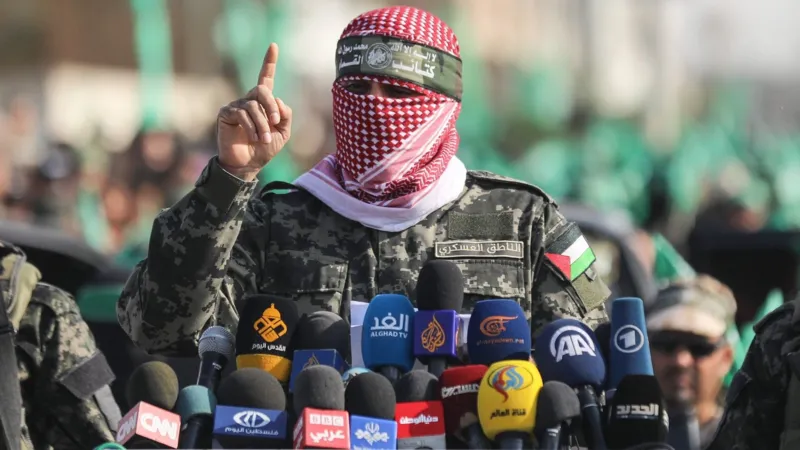
Abu Obeida, whose real identity was revealed as Huthaifa Samir al-Kahlout, had served as the masked voice of Hamas’s military operations since 2005, becoming an iconic figure across the Arab world with his distinctive red keffiyeh and thunderous pronouncements. His death represents a significant blow to Hamas’s propaganda apparatus and removes one of the group’s most effective communicators during the ongoing conflict with Israel.
Biography of Abu Obeida
Born Hudhaifa Samir al-Kahlout on February 11, 1985, Abu Obeida grew up in the Jabalia refugee camp in northern Gaza, where he developed early connections to the Palestinian resistance movement. He joined Hamas at a young age and quickly rose through the ranks of the Ezzedine al-Qassam Brigades, demonstrating particular aptitude for media and communications.
In 2005, al-Kahlout was appointed as the official spokesperson for Hamas’s military wing, adopting the nom de guerre Abu Obeida (also spelled Abu Obaida or Abu Ubaida in various reports). He immediately established his distinctive style – always appearing with his face completely concealed by a red-and-white keffiyeh, his voice modulated to maintain anonymity while projecting authority.
His rise to prominence began in 2006 when he announced the capture of Israeli soldier Gilad Shalit, a moment that catapulted him into the international spotlight. Over the next two decades, Abu Obeida became the primary channel for Hamas’s military communications, particularly during Israeli military offensives in Gaza. His theatrical delivery and carefully crafted messages made him both a propaganda asset for Hamas and a frequent target of Israeli intelligence services.
The new spokesperson revealed that al-Kahlout was also known as Abu Ibrahim and served as head of al-Qassam’s media apparatus, indicating his role extended beyond simply being a spokesman to overseeing the entire communications strategy of Hamas’s military wing.
Circumstances of His Death
Abu Obeida met his end on August 30, 2025, during a targeted Israeli airstrike on the Rimal neighborhood of Gaza City. According to multiple sources, the attack struck an apartment building where the spokesman was located, killing him along with at least 10 other people and injuring more than 20.
The Israeli Defense Forces had been pursuing Abu Obeida for years, with multiple previous assassination attempts failing to eliminate the elusive spokesman. Israeli Defense Minister Israel Katz confirmed the successful operation the following day on August 31, stating that the Hamas armed wing spokesman had been “eliminated” in the strike.
The attack occurred during a period of intense Israeli military operations in Gaza City as part of the broader conflict that began with the October 7, 2023 attacks. Abu Obeida had delivered his last recorded statement on July 18, 2025, just six weeks before his death, continuing his pattern of taunting Israeli forces and boasting about Hamas’s military capabilities even as the organization suffered significant losses.
The precision of the strike suggests sophisticated Israeli intelligence gathering, possibly through human sources, electronic surveillance, or other means that finally pinpointed the location of the notoriously secretive spokesman who had managed to evade detection for two decades.
Impact on Hamas and Gaza
The confirmation of Abu Obeida’s death, along with several other senior Hamas leaders, represents a substantial blow to the organization’s leadership structure and propaganda capabilities. The new spokesperson who announced the deaths also confirmed that Mohammed al-Sinwar (brother of Hamas leader Yahya Sinwar and former commander of the Qassam Brigades) was killed by Israeli forces in May 2025, along with other senior figures including Raed Saad (commander of military manufacturing) and Hakam al-Issa.
For the Palestinian population in Gaza, Abu Obeida’s death removes a symbolic figure who had become a source of psychological resilience during the conflict. His regular appearances, even when filmed in undisclosed locations, provided a sense of continuity and defiance against Israeli military pressure. The fact that Hamas waited nearly four months to confirm his death suggests the organization recognized the demoralizing effect this announcement might have on its supporters.
The immediate appointment of a new spokesperson using the same nom de guerre indicates Hamas’s attempt to maintain continuity in its communications strategy. However, replacing a figure who had built two decades of credibility and recognition presents significant challenges. The new Abu Obeida lacks the established reputation and symbolic weight of his predecessor, potentially weakening Hamas’s ability to shape narrative and morale.
Internally, the loss of such a senior media operative likely creates operational challenges for Hamas’s communications apparatus, particularly in coordinating messaging between military and political wings during a period of intense conflict.
Conclusion
The death of Abu Obeida marks the end of an era in Hamas’s history and the broader Palestinian-Israeli conflict. For twenty years, his masked presence and distinctive voice served as the auditory signature of Hamas’s resistance narrative, evolving from announcing the capture of Gilad Shalit to becoming the primary voice during the devastating 2023-2025 Gaza war.
His elimination represents a significant intelligence and operational success for Israel, removing one of Hamas’s most effective propagandists and symbolic figures. However, it also creates a vacuum that Hamas will struggle to fill, both in terms of operational communications and psychological warfare.
The circumstances surrounding his death – killed in a targeted strike four months before the announcement – reflect the cat-and-mouse nature of this conflict and the ongoing battle over narrative control. As Hamas attempts to maintain continuity with a new spokesperson bearing the same name, the organization faces the challenge of preserving its messaging effectiveness while adapting to the loss of one of its most iconic figures.
The death of Abu Obeida, along with other senior leaders confirmed in the same announcement, suggests Israel’s targeted assassination campaign has significantly degraded Hamas’s leadership structure, though the long-term impact on the conflict’s trajectory remains uncertain.